Thursday, 4 April 2013

Temple for -Get rid of past sins-Sarangapani Temple of 108 Divya desam Temples

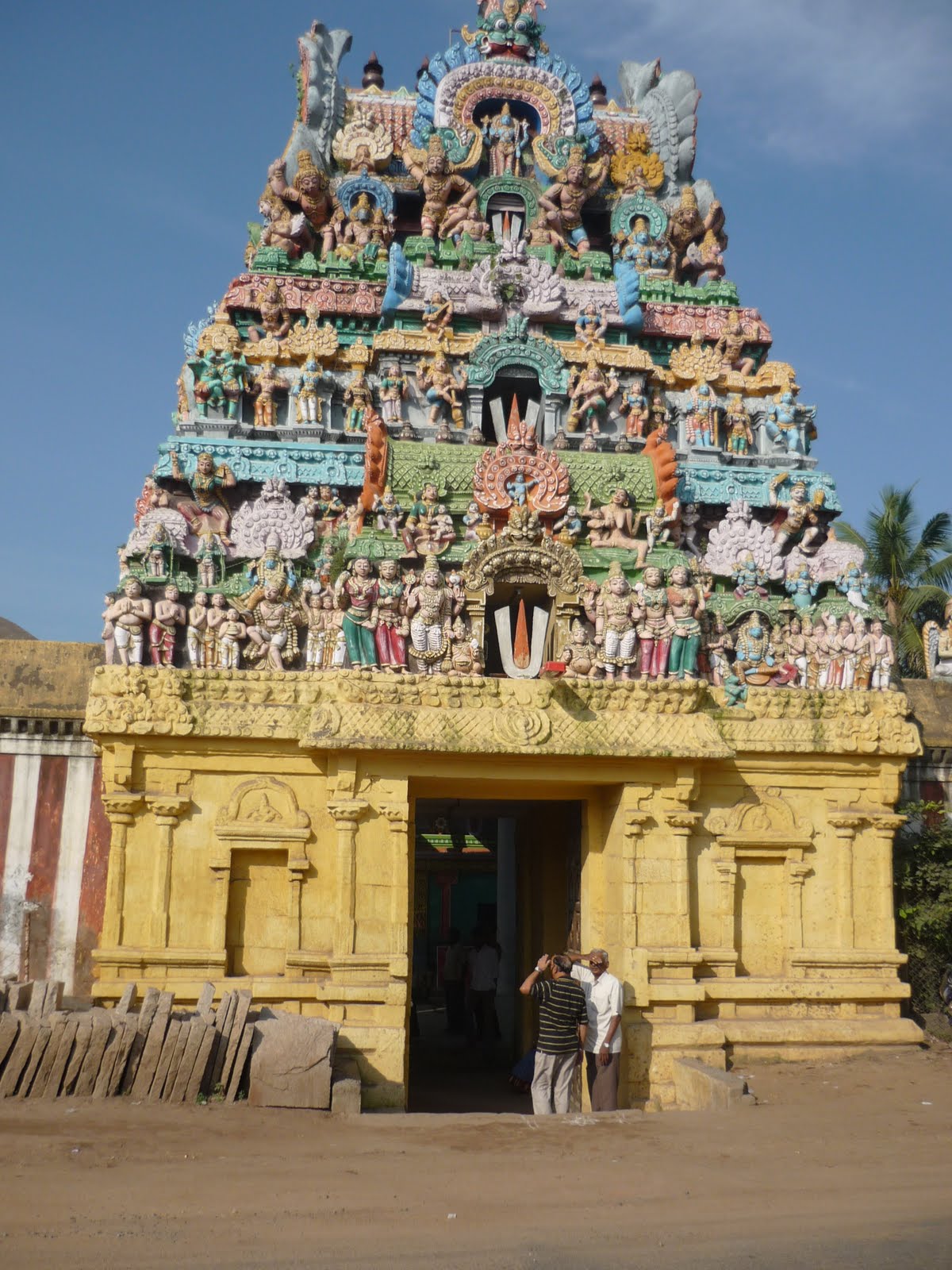
                                                          Sarangapani Temple


Car festival of Sri Sarangapani Temple was held here on Wednesday. Thousands of devotees pulled the car along the four streets around the temple.The tastefully decorated big car (next to Tiruvarur and Srivilliputhur temple cars) weighing 300 tonnes started from its stand at 11.30 a.m. and went its way via the four streets and came to the stand in the evening.

Earlier in the morning Sarangapani Perumal along with Upayanachiar was taken to the car from the temple in a procession.After arthis and pujas were performed, devotees started pulling the car. Sarangapani Temple occupies the third place in the 108 Vaishnavite Thirupathis. Seven Alwars have done Mangalasasanam of the Perumal.
Jeers of Sri Ahobila Mutt participated in the festival. The temple has two car festivals one falling in the Tamil month of ‘Chithirai’ and another in ‘Thai.’ The car festival was not held for many years in between.
Ko.Si. Mani, Co-operation Minister, who represents Kumbakonam constituency in the Assembly, took efforts to run the car. The huge car was renovated and the festival re-commenced in 2007. But encroachments on roads hindered and delayed the movement of the car then. Now roads have been re-laid and widened to ensure that the car festival passed off smoothly on Wednesday.


Lord Aaraavamudhan is credited with helping the compilation of Naalaayira Divya Prabandham
Pancha Ranga Kshetram
Sarangapani Koil has maximum number of Azhvaars singing praise of Lord Vishnu after Srirangam and Tirupathi

The 2000 year old Sarangapani Aaraavamudhan temple is housed between two rivers, Cauvery and Arasalaaru, in the heart of Kumbakonam, once the capital of the Chola Kingdom. 3rd Tallest Temple Tower. This temple has the third tallest temple tower among the Divya Desams at 150ft after Srirangam(236ft) and Srivilliputhur(192 ft).
one among the three major shrines dedicated to Lord Vishnu. The largest 11 storey gopuram is 44 meter tall and has the dancing poses of Shiva, a rather unusual feature in a vaishnavite shrine. There are two entrances, uttara vassal – opens when the sun reaches the tropic of Capricorn, in the north and dakshina vassal – opens when the sun reaches the tropic of Cancer, in the south.
Some parts of the temple is believed to have been built in the 7th Century AD by the famous Pallava King Mahendra Varma but the real construction of the temple is said to have been done by the Cholas and later renovated by the famous Vijayanagara King Krishnadeva Raaya.
In an effort to test the patience of the Tri-Murthies and in order to find out as to who is most patient, Sage Brigu once kicked Lord Vishnu on the chest. An embarrassed Goddess Lakshmi left the Lord, who in search of her came to Tirupathi. At Tirupathi, the Lord got married to Goddess Padmavathi. To save himself from an angry Goddess Lakshmi, Lord Vishnu is said to have hid inside a small cave here. To this day, one can see a small Sannidhi below the earth inside this temple, near the sanctum sanctorum.
Undertaking penance to repent his arrogant action, Brigu was reborn as Hema Rishi and Goddess Lakshmi was born as his daughter. It is said that Brigu gave his daughter in marriage to Lord Sarangapani.


Compilation of Naalaayira Divya Prabhandham
After listening to the Tamil hymn ‘Aaraavamudhe’(3418-27) composed by NammAzhvaar and totally swarmed by its content ” Aayirathil Ippathe”( 10 verses in 1000), Vaishnavite savant Natha Muni wanted to listen to the 1000 verses of Divya Prabandham. Not knowing where to go to collect the entire Prabandham, Natha Muni is said to have prayed here and Lord Aaraavamudhan asked him to go to Azhvaar Tirunagari, near Tirunelveli, to meet NammAzhvaar and to compile the works of the Divya Prabandham. Having searched for the 1000 verses, Natha Muni actually got to compile all the Nalaayira Divya Prabandham. Being responsible for the compilation of the famed 4000 verses by showing Natha Muni the right direction, the Lord here is also called ‘Aaraavamudha Azhvaar’.
He is also called ‘Tamizh Vedham Thantha Vallal’.
“Aaraavamudhe Adiyen Udalam, Ninbaal Anbaaye
Neeraal Alainthu Karaiya Urukinra Nedumaale
Seeraar Sennel Cauvery Veesum, SezhuNeerth ThiruKudanthai
EraarKolam Thigazhak Kidanthaai, Kanden Emmaane”
(Lord, I see you in resplendent reclining form in ThiruKudanthai, amidst Fertile waters and Paddy fields…………….)
ThiruMazhisai Azhvaar and ‘Slightly Raised Reclining Posture’ of the Lord-Uthaana Sayanam
Seeing the sleeping posture of the Lord, a curious ThiruMazhisai Azhvaar questioned if his tiredness was the reason for him to be lying down in his sleeping posture. After hearing this, it is believed that the Lord slightly raised his posture to greet the Azhvaar. Feeling the guilt of having caused strain on the Lord, ThiruMazhisai Azhvaar asked him to remain as is. And the Lord remained so ever after. To this day, one can see the Lord in a slightly ‘raised reclining’ posture(Uthaana Saayee).
‘Nadantha Kaalgal Nonthatho Nadungu Nyaala Menamaaya
Kidantha Mei Kulungavo Vilangu Maal Varaichuram
Kadantha Kaal Parappik Cauverik Karaik Kudanthaiyul
Kidantha Vaare Ezhunthirunthu Pesu Vazhi Kesavane’

Azhvaars praising the Lord
Also, after Srirangam (11) and Tirupathi (10), the Sarangapani temple has the maximum number of Azhvaars (7 of them) singing praise of the Lord.
Sarangapani temple boasts of one of the biggest temple chariots and is said to have been given to the Lord by ThirumangaiAzhvaar himself.


Thiru Pallaandu and Sarangapani
PeriyaAzhvaar in his ThiruPallaandu refers to the Kudanthi Lord “Saarngam Ennum Villaandaan Thannai…” ( the Lord with a ‘Sarangam’ bow in hand….)
Sanctum housed on a Chariot
Lord Vishnu is said to have come down from Vaikuntam in his chariot to marry Goddess Lakshmi here at Kudanthai. The main sanctum has been conceived like a chariot with wheels drawn by horses and elephants and is truly a splendid sight to watch. There are two entrances to the sanctum sanctorum, the southern entrance and the northern entrance (each is open for 6 months in a year). There is no straight entrance to the sanctum. The Utsav moorthy here is regarded with the same importance as the Moolavar.
As seen in the previous story( Srirangam) Lord Ranganatha had settled down with the Prana Vaakruthi Vimaanam on the banks of Cauvery in Srirangam. The Lord also told Vibheeshana that he would settle down with the Vaidheega Vimaanaam at Kudanthai. Hence, this temple is 2nd only to Srirangam among the Divya Desams.


The Name ThiruKudanthai
Foreseeing some difficult times, Brahmma placed the Vedhic content, nectar and the seeds of creation inside a pot (Kudam in Tamil), which then slipped all the way and down to this place.
Shiva pierced the pot and the nectar flowed in two parts – one into the Mahaamagam Tank and the other into the Lotus Flower Tank. As the nectar flowed into the tank through a pot (Kudam), this place came to be called Thiru ‘Kudanthai’

A visit to this temple, it is believed, will help get rid of one’s past sins, just as a trip to Kasi in the North, would. It is sacred to bathe in the lotus water bed in the temple tank.
Lord does Shraadham for a Brahmin

Lakshmi Narayana Swami was a brahmachari and was devoted to Lord Aaravamudhan. It was he who built the Raja Gopuram. He was worried about his final rites as he was a brahmachari. Pleased with his devotion, the Lord himself is said to have performed the final rites. Also, every year, in the Tamil month of Aipasi, the Lord is said to perform the Shradham for Lakshmi Narayana Swami.

PanchaRanga Kshetram
ThiruKudanthai is a Pancha Ranga Kshetram
“Anya Kshetra Kriya Paavam, Punya Kshetra Vinasyathi
PunyaKshetra Kritham Paavam, Vaaraanasya Vinasyathi
Vaaranasya Kritham Paavam, Kumbakonam Vinasyathi
Kumbakonam Kritham Paavam, Kumbakonam Vinasyathi”

Festivals
There is no swarga Vaasal at the Saarangapani temple. About 50000 people are expected to attend the Vaikunta Ekadesi festival.There are festivals all through the year at this temple. Other Temples to visit: Raamaswamy ( Raama in a grand standing posture) and Chakrapani temple.

Quick Facts:
Deity : Aaraavamudhan – East Facing, Raised Reclining Posture
Goddess : Komalavalli Thaayar
Mangalasaasanam : 7 Azhvaars- PeriyaAzhvaar, PeyAzhvaar, BhoothathAzhvaar, NammAzhvaar, Thirumangai Azhvaar, Thirumazhisai, Andaal,
Paasurams : 52
Temple timing : 7am –12 30pm and 4pm-8pm
Contact : gokulprasa@gmail.com


Temple for heal poisonous insect bites-Airavateswarar Temple, Maruthuvakudi


          Airavateswarar Temple, Maruthuvakudi


Airavateswarar Temple is a Hindu temple located at Maruthuvakudi near Aduthurai in the Thanjavur district of Tamil Nadu, India.
In this temple's history, Indira, the lord of Heaven, and his Iravatha, his white Elephant, were cursed by Saint Dhurvasa for sinfully throwing a garland given to them by Brahma. Indira lost his Kingdom and the Iravatha turned black; she worshipped Lord Shiva here and was eventually released from the curse. It is also the place where Lord Shiva slew an evil demon, Marutthuvasura, from which the name of the village originated from.
Another important deity of this temple is the Goddess Abirami Amman, who is worshipped here as well as in the famous Thirukkadaiyur temple. In addition to Thirukkadayur, there are five temples where Abirami Amman is found. This temple is one tribute.
The structure of Shiva is said to be made of white clay, formed as "Suyambu" — which, according to tradition, was not sculpted by man but formed spontaneously. The other main statue, which is of Nandi faces the Shiva's statue, and is located slightly away from its original position. It is named Baana Nanadi and looks pored on its surface. It is believed the Nandhi was injured with Maruthuvasura's 'Baanas' (arrows) and protected Lord Shiva.
The next most famous God here is Lord Ganesh, also named "Viruchika Vinayagar", who has a trunk resembling Virchika-Scorpion. He is believed to be able to heal poisonous insect bites of those who worship him.
The temple structure was constructed from bricks and stone. It is built with dravidian architecture in the Chola style. The Gopuram is built six stories high. It was said to be built during the period of SembiyanMadevi, during the reign of the Queens of the Chola Dynasty, which is attested by some stone carvings at the temple. The temple was ruined then restored.
The "Kumbabhishekam" (consecretion ceremony) of this temple recently took place on 31 August 2006. This Kumbabishekam was performed at this temple after 200 years.
The famous Tamil Nadu Rice Research Institute is located beside the temple is one of the landmark.

Temple for Education-Saraswathi Temple in Kuthanoor near Kumbakonam


There are only few temples for Goddess Saraswathi. Among the rare temples, Kuthanoor saraswathi temple is very famous in Tamilnadu. It is believed that people can get all the glory and blessing for their life from Goddess Saraswathi if they show perfect dedication towards Goddess Saraswathi in Kuthanoor temple. Read this article to find complete details about the temple. 

Saraswathi Temple in Kuthanoor near Kumbakonam

There are many significant temples in tamilnadu that are very good and popular for its greatness and the gods and goddess present in the temple. It is not a easy thing to find Saraswathi temples in India as there are only few Saraswathi temples when compared to the other temples. This brings the specialty of the Lord Saraswathi temple in Kuthanoor which is near Kumbakonam and Tanjore. Lord Saraswathi is very popular and called by various names but there are only few temples available for Lord Saraswathi in Tamilnadu. As we all know, Saraswathi is the main god for the studies and if Saraswathi is worshiped with full dedication, we can gain the knowledge and wisdom in all the things. 

Greatness of Lord Saraswathi
Lord Saraswathi is also called with a name called Veenavahini as she is having a Veena in her hand. Saraswathi is the wife of Lord Brahma who is the creator of this world. As per the order from Lord Shiva there is no temple for Lord Brahma in the world, but there are some temples for Lord Saraswathi which helps in worshipping the goddess of learning and get all the knowledge and wisdom that is necessary for a wonderful life. Lord Saraswathi takes her position with a Veena in hand on a beautiful lotus flower. She can be seen with several arms each holding something. One hand will be holding the Kamandalam, the other with a Japamala, two lower hands will be placed in a position of Chinmudra which denotes the Thapas done by her and the other hands will be having the Palm leaf manuscript. These are the things that are general about Lord Saraswathi. The one who worships Lord Saraswathi with proper dedication will get all the knowledge and wisdom to sustain a great life.

About Koothanur Saraswathi temple near Kumbakonam


Among the rare temples that are for the Lord Saraswathi, Kuthanoor temple is a very popular and a very famous temple among the people of Tamilnadu. It can also be said that the people bring their kids to this temple for the prayer before they are first sent for their studies. We can see Lord Saraswathi in several temples all over India and it is very rare to find a temple for Lord Saraswathi with a separate shrine for her. The legendary stories tell about the greatness of the Kuthanoor Saraswathi temple. 

There are also some stories describing the reason for the name to be Koothanur for the place and for the temple. Once there was a young devotee who was sincere on his devotion performed a serious worship in front of the shrine of Lord Saraswathi in order to seek the grace of the goddess. In order to bless the devotee with her desire, Lord Saraswathi came as a courtesan in front of the devotee in order to pour her blessing. The devotee was not aware of who that was and because of that he had to refuse the blessings offered by the courtesan. Hearing what happened there, Ottakkoothar gave a fast move to the incident spot. He understood who has come as the courtesan and later on the poet showed his desire for her blessing by prostrating. Because of this the fame of Ottakkoothar was spread all over Tamilnadu and his greatness was recognized and infact he is the reason for the name Koothanur to be given for this place. The name was exactly derived from the name of the poet Ottakoothar. 

History of Kuthanoor temple based on three sacred rivers

Kuthanoor Saraswathi temple history is associated with the joining of the three sacred rivers such as Ganga, Yamuna and Saraswathi. The three sacred rivers merge here and are called as Harisol River and in Tamilnadu it is popularly called as Arasalaaru. Ganga lies in the head of Lord Shiva and it is believed that Lord Shiva was attained by Ganga from this holy place. For good things to happen the River Ganga was separated from Lord Shiva and he was facilitated to marry Parvathi. After the marriage of Goddess Parvathi and Lord Shiva, they gave birth to Lord Muruga who was created in order to kill the demon named Tarakasuran who troubled the Devas. After this process was completed, the River Ganga joined with Lord Shiva in this place. 


Lord Saraswathi was the wife of Lord Brahma who was the lord of creation. Saraswathi had an ego clash with Brahma and the argument finally let to the birth of Saraswathi in the earth. After the birth on the earth, both Brahma and Saraswathi worshiped Lord Shiva to solve their ego clash and realized that they are equal. Then later Saraswathi merged with Harisol and was also blessed to have a separate shrine for her in the banks of this river. Brahma was already in a curse of not having any shrines in the world for some different issue. After the request to Lord Shiva for the rituals to be performed in the temple for the departed souls, the Lord Shiva allowed him to do so. With this declaration, Brahma Pooja is performed in the temple which has a very greater significance. 

The other story associated with the Yamuna River is that, once Yamuna was tempted because of the acts of Lord Shiva with the Gopikas. Because of this she was given a curse. In order to get relief from the curse she came to this place and prayed for the emancipation. And based on her request, her curse was removed and again she got the river form. This was also happened in this holy place and the River Yamuna merged with the other two rivers as Harisol. 

But according to the history there is also a different story. The work Koothanur comes because of the naming given to a village by Raja Raja Chola II. The village was given to the Ottakkoothan that made the place very famous as it has the popular temple dedicated to Lord Saraswathi. Also the placed gained more popularity because there are only limited Saraswathi temples all over the world. Most of the devotees come here for the education of their children and also to get the blessing of Lord Saraswathi in order to gain knowledge and wisdom for better living. The liberation is also attained from the previous births if the people who come there take bath in the auspicious Triveni Sangamam which is the combination of three rivers mentioned above. 


How to get the blessing of Lord Saraswathi
In general the blessing of Lord Saraswathi cannot be attained easily. Bhaskarar who is a very great philosopher and writer, the one who wrote the famous Sri Lalitha Sahasranama Bhashyam for Goddess Saraswarthi has told that this birth cannot be the one reason for attaining the blessing of Lord Saraswathi, it is necessary that a person should have also done good things in the previous births. So the previous birth is also responsible for a person to get the blessing of Lord Saraswathi. There are also various scripts in out Hindu religion to praise the greatness of Lord Saraswathi and also there are procedures and pooja to be followed to get the grace from Lord Saraswathi. The shrine of Lord Saraswathi in the temple will be very attractive such that the people who give a visit will be fulfilled with all the needs that are required for them. 

Greatness of Kuthanoor Saraswathi Temple

The greatness of the Kuthanoor Saraswathi temple comes with the grace of the Lord Saraswathi. As mentioned above, the temple is unique as there are not many temples for Lord Saraswathi. Although there are temples which are having separate shrines for Lord Saraswathi and Lord Brahma, it is very rare to see the temples that are completely dedicated to Lord Brahma or Lord Saraswathi. This is the reason why the Saraswathi temple is very famous and popular among everyone. It is said that the Poet Ottakoothar created this shrine in the early days nearly in the second millennium and also it is said that he also celebrated the great Vijaya Dhashami festival which is completely dedicated to Lord Saraswathi. 

Along with this there are also various inscriptions and writings on the stones of the temple that describes the greatness of the temple and the goddess in the temple. This also represents a great validation to describe about the greatness of the temple. The temple is completely dedicated for the children and for their studies. There is a great even happening for the children on the full moon day as the children are written with the powerful “Om” on their tongue with the help of a stick that is dipped in the honey. It is said that this will bring out the talent from that particular child and it will make him get dedicated towards the studies. 

Kumbabhishegam is also done in the temple every 12 years. The previous Kumbabhishegam years are 1941, 1968, 1987 and 2003. There are also many great legends like Purushotham Bharathi, Ovathakoothar and Ottakoothar, who worshipped the goddess in this temple and got the blessings of the goddess. There are also shops available to get notebooks and pens there. The notebooks and pens are taken to the temple and are kept in the feet of Lord Saraswathi and brought in order to get good dedication towards the studies. 

How to reach Kuthanoor Saraswathi temple near Kumbakonam

The location of the Kuthanur temple is near Kumbakonam. The temple can be easily reached from various places in Tamilnadu with the help of any transport. There are various bus facilities available to reach the temple from Kumbakonam, Mayiladuthurai, Tanjavur etc. There are also various other temples nearby making the place more special. Every year more than thousand people visit the temple to get the blessing of Lord Saraswathi. Offering Lotus flower to Lord Saraswathi is a special in this temple. The vijayadashami festivals are also celebrated in a great manner in the temple with serious arrangements. It is easy to reach the temple from Kumbakonam. 


Temple for "The marriage Specialist"-Kalyanasundarar Temple -Thirumananjeri

 Kalyanasundarar Temple -Thirumananjeri


About Temple :

Among the myriad temples in and around Kumabakonam and Mayavaram Kalyanasundarar temple Thirumananjeri is a famous Prarthana sthala.

It is believed that unmarried boy or girl will enter into wedlock if they propitiate the presiding deity Kalyanasundarar and his divine consort- Kokilambal.

WORKING HOURS:

Thirumananjeri: Marriage archanas are performed only from 8am-1pm and from 3.30pm to 8.30pm on normal days and from 7am to 9pm without a break on Saturdays/Sundays; Fri/Sat/Sun/Govt.holidays/Muhurtham days are very crowded (500-1500 spouses per day; 100-120 per batch; one batch takes about an hour); other days : 100-200 spouses per day; one batch has 10-20 spouses; takes 30 mts per batch; batch starts every 30-40 mts and so need not hurry;

Parents can partake on behalf of their children if the boy / girl is unable to visit in person.

General timings for all temples in Tanjore district : 0800 – 1200 and 1600-2000 hrs definitely open; one hour leeway is possible on either side; hence check locally. Max. is 0700 – 1300 and 1500-2100 hrs.


AUSPICIOUS TIMES AT THIS TEMPLE:

All times are considered auspicious since Lord Shiva and Parvathy are in a bliss here always.

Temple observes no Raagu kalam, Emakandam, Kuligai kalam, Ashtami, Navami etc.

Daily Pooja:

Daily six poojas takes place in this temple namely Ushakkalam, Kalai Santhi, Uchikalam Sayaratchai, Irandam Kalam,

and Artha Jamam.

Weekly Poojas

Due to the welface of the world every Tuesday and Friday Sahasranamam and Lalitha Thiruchathi Archanas

will take place. Common prayers also will be conducted.

Monthly Poojas

Every 1st day of Tamil month 'Karthigal' and during Pradosham special Abisheham will be done.

During 'Sangadahara Sathurthi' and 'Pooja Natchathiram' special Abisheham along with 'Umamaheswara Homam'

will be done to Kalyana Sundarar.

Annual Poojas

Navarathiri, Vijayadasami, Thirukkarthigai, Aruda Dharshanam, Festivals takes place. Every year during

 Tamil month 'Chithirai' Thirukkalyanam Festival will be celebrated in a grand manner.

The devotees can offer 'Ashtothram' and 'Sahasranama Archanais' from 6 a.m to 8.30 p.m every day.
   

LOCATION:

Tamilnadu; Thanjavur District; 10 km west of Mayuram (Mayiladuthurai) as the crow flies.

CAR ROUTE:

Cabs are available in almost all places like Thanjavur, Kumbakonam, Mayuram, Seerkazhi, Chidambaram and even in small towns like Kuthalam.

Mayuram to Thirumananjeri Direct route: 10km without going to Kuthalam (saves 10km since Mayuram-Kuthalam-Thirumananjeri is about 20 km): enter from east/Thirukkadaiyur, take right at Y-Jn (for Kuttalam/Kumbakonam Rd take left here) – go thru bazaar 2km – take left adjacent to the HP Petrol Bunk – take right at T-Jn 300 M away – take left at T-Jn 200 M away – drive 7-8 km straight till you reach a vaaikkal (this is a good tar road 20 feet wide)- when you see a board “Thirumananjeri Temple route’ take right – drive in 8-feet tar/gravel road for 2 km – cross aathuppalam [30 feet wide bridge 50 feet long] – 1 km- enter Thirumananjeri; if you miss the right near the board, proceed straight and join the Kuthalam-Thirumananjer Road where you can take the right.

From Kumbakonam : Take SH64 towards Mayuram, go 16km to Aduthurai, 11 km to Kuthalam, take left 8km to Thirumananjeri = 35 km approx. Faster route but cannot visit Suryanar Temple if you want to.


Another route from Kumbakonam : Take SH64 towards Mayuram, go 16km to Aduthurai, take left 4 km to Suryanar kovil, 6 km to Kanchanur, 9km to Thirumanancheri = 35 km approx.

TEMPLE PROCEDURES:

Before entering temple:

Car Parking is available in front of the gopuram on normal days; on weekends it is difficult to get parking.

Leave chappals in the car itself, if possible.

Buy archana thattu/bag INSIDE the temple, not in the outside shops though shopkeepers will keep pestering you.

Buy Archana tickets inside the temple in the counter:

For marriage : Rs.15; Puthira Dosha archana : Rs.5; normal ashtothram archana : Rs.2/ticket;

Buy ghee dheepam thattu (Rs.20 for 5 lamps) near the archana counter, not outside. If possible, take original ghee from home since ghee sold there may be dalda. Clay lamps are available there (or we can take from home).

Step-1: Go into the temple; Selva Ganapathy is on the left of sanctum sanctorum: pray before him first.

Step-2: Pray Lord Shiva (Sri Uthvaganatha Swami) next and go to Amman Sannithi on the right. Meenakshi Amman here appears as a 13-year old Kokilambal, head slanted to her right, with three bends (”naanikkoni’). This kolam is before her marriage.

Step-3: On the left of this mandapam is the important Kalyana Sundareswarar sannithi and mandapam. Light the ghee deepams first, right opposite to the Kalyana sundareswarar sannithi (except for mangala raagu which has separate place for ghee dheepams); here the deities are in marriage kolam; Meenakshi is on his right looking at the floor in kalyana kolam; hence married girls should always stand on the right hand side of the groom during all auspicious functions; the priests perform the rituals here to remove our marriage obstacles. Details are given below.

Marriage delay Pariharam:

Unmarried spouse should buy one set of archanai thattu/bag; there are two places where you can buy this thattu; there are ten shops just outside the temple which sell this thattu at Rs.80 for boys and Rs.90 for girls [because manjal kayiru is added] containing 2 garlands, 2 coconuts, one lemon, vetrilai paaku, kalkandu; the same thattu is available inside the temple also at Govt (HR&CE Dept)-fixed price of Rs.40 & 45 sold by an HR&CE employee; always buy it inside the temple in Tanjore temples.

As soon as you enter the Kalyanasundareswarar sannithi, light the dheepams first and then wait for the next batch; only girls and boys concerned are seated inside the enclosure and those accompanying should sit around this enclosure; couples who come after marriage to complete the rituals and the parents (of boys/girls who are unable to come in person) also can sit inside the enclosure; if you are parent(s) inform the priest as soon as you enter the enclosure.

The priests brief you first regarding the Do’s and Don’ts; then collect all the garlands and the archana tickets first; they keep all garlands at the feet of the god, return one garland each to the spouse to be worn, parents must keep it in their hands; sangalpam is done and the thattu is taken away; parents should tell the boy/girl’s gothram/name/star and not theirs; archana follows, coconuts are broken, thattus are returned after aarthi as usual; drop Rs.10 or so in the thattu for the priests.

Do’s and Don’ts:

Vibuthi, kumkum (plus manjal for girls) are to be used, after prayers, for one mandalam (45 days or till they last) by the boys/girls only and NOT by others in the family.

Lemon should be drunk, without adding salt or sugar, by the boys/girls only and NOT by others; the next morning after bathing the boy/girl should pray wearing this garland and then drink the lemon juice with a little water.

Then retain the garland in a cloth bag (manjal pai), not in plastic bag, till marriage is over and come again with spouse; the same garland is finally put in the temple tank here.

Coconuts can be used by the entire family for cooking.

Step-4: After these rituals at the Kalyana sundareswarar sannithi, go and pray Shiva again. Normally no separate archana is done here.

Step-5: The kalyana melam/Nadhaswaram party collects Rs.10/boy or girl while coming out of the sanctum sanctorum, though not compulsory.

Step-6: Pray Raagu. Mangala Raagu here in the north of inner praharam is special for puthira dosha nivarthi; normal ghee dheepam (5 for Rs.10) available near Raagu, should be lit only by the boy or the girl or one of the parents if the boy/girl has not come;

Full procedure for Puthira dosha pariharam:: take bath in the thirukkulam nearby on amavasai day and take paal payasam for puthira bagyam; childless couple should offer ghee which is returned as prasadam which is to be taken at night for 48 days by both.


HISTORICAL / RELIGIOUS IMPORTANCE:

10th Century Chola Temple.

There is a moat around the temple.

Once upon a time, Parvathy wanted to marry Shiva in an earthly marriage with all religious rites on the earth; Brahma, Vishnu and Indira came to earth as acharya in Thiruvaduthurai; while playing chokkattan (similar to Thaayam), Vishnu won and his sister Parvathy laughed aloud; Lord Shiva was angry and said “Ada pasuve!” and Parvathy was born as a cow on earth; Vishnu became her herder at Therazhundur; Barathamuni had no children and he prayed the Lord; he was given permission to remove her curse and so he converted her cow shape to a feminine figure at Thiruvavaduthurai; she grew up at Kuthalam alias Thiruthuruthi in Bharathamuni’s house; Lord Shiva came to marry her as promised earlier and Barathamuni received him at Ethirkolpadi; Shiva performed all the marriage rites / velvi at Velvikkudi before marriage; then he married Parvathy at Thirumanancheri. Shiva hence gets the name ‘Pasupathy’.


Six Kalyana sthalams, all around Mayurm / Mayiladuthurai are:

1. Therazhundur (Vedhapureeswarar – Soundaryanayagi) – 11km from Mayuram.

2. Thiruvaduthurai

3. Kuthalam.

4. Ethirkolpadi.

5. Velvikkudi.

6. Thirumanancheri.

The following story also keeps floating around: Two girls promised each other that their son and daughter would marry in future; one got a beautiful girl while the other gave birth to a turtle-shaped boy; former refused the marriage; the latter appealed to the Lord; he converted the turtle to a handsome young man; marriage went off well; so goes the story; hence the belief is that the physical disabilities of the spouse will be either corrected by the Lord or overlooked by the other spouse; hence the marriage obstacles would be removed once you come and pray here.

To bless the devout multitude on earth Lord Shiva and Parvathi got married in five different types. The celestial wedding that took place in this sacred spot was performed according to the sastras followed by human beings.

The wedding of Shiva and Parvathi

When Shiva and Parvathi were in a happy mood in their abode in MT Kailash a strange idea struck Parvathi. Instead of the usual fight that separates the couple after which they unite in wedlock , Parvathi thought it correct and logical to request Shiva to marry her another time.

Parvathi requests Shiva to marry her

Parvathi requested Shiva to marry her again which he accepted with joy and also informed the time of their wedding. Parvathi became impatient as there was a fairly long time for the marriage. She became callous and cold shouldered Shiva.

Shiva gets angry

Shiva watched her behavior and in a fit of anger cursed her to be separated from him and take the form of a cow. Parvathi incarnated as a cow and roamed in the jungle. She was always thinking of her spouse while loitering in Asukadau( forest) he divine cow -Parvathi spotted a Lingam and showered it with milk from its udder. Shiva was overjoyed to see the devotion of his consort.

Mukti at Thruvavadurai

Shiva happy with Parvathi’s (cow)deeds and granted Mukthi to her Thiruvavaduthurai. He was contemplating as to how Parvathi could be born on earth so that he can marry her quickly.

Bharatha Maharishi was conducting a yaga and Shiva thought it apt to make Parvathi appear from the yaga kundam. Thus a divine damsel emerged from the yaga kundam and the sage Bharatha was happy to see her and considered as a holy girl. He was worried about finding a suitable groom for her. The Lord appeared in his dream and assured him that he -Shiva would marry her as she is none other than Parvathi. Shiva also wished

Lord Shiva appeared in the dream of Sage Bharatha, that he will enter into wedlock with the celestial who appeared from Sage Kundam.

Thus the Sage meticulously looked after the wedding arrangements. The divine wedding took place in Thirumananjeri which was witnessed by celestial beings. Since the Thirumanam (Wedding) took place at Thirumananjeri, this place is called Thirumananjeri.

Praying For Marriage

There is a popular belief that unmarried men and women will get married by worshipping the Lord and his consort. All the pooja items which is required to propitiate the deities are available inside the temple. But there are shops adjoining the temple who sell the pooja items.


There are many unmarried men and women who are grouped to propitiate the deities. The priests conduct the rituals precisely and the pooja with the reverence. Rathi and Manmadhan were united in wedlock in Thirumananjeri.

One should visit Thirumananjeri only after completing their visits to other places. This temple should be the last leg in their tour. Faith can move mountains. Reposing faith in the deities will do wonders. Unmaried men and women who prayed for their wedding should compulsorily visit Thirumanajeri after their wedding and follow the ritual as ordained by the priests.

There is a separate shrine for Rahu of the Navagraha. The childless will get a progeny if they worship him thus called Mangale Rahu and worshipping him consecutively on three New Moon days will remove the malefice effects of Navagraha.

Thiruvizha:

In the Tamil month of Chithirai on Poosam star; Shiva’s Thirumana Mahotsavam.

PERSONAL TIPS for Thirumanancheri:

Best time to visit: least crowded on weekdays especially during exam periods.

Food: Take food with you since nothing except tender coconuts and biscuits is available.

Toilets: no specific place as rest rooms; the whole world is yours!

Accommodation: Nothing is available there since none stays there; very small guest house is there for an emergency.

Dress code: no code; pants, dhothi, shirts, saree, chudidhar etc are ok;

Priests: only one priest stays locally; others come from nearby towns daily.

Medical facilities: none; nearest is Mayuram or Kumbakonam.

Cabs / Taxies: not available locally; town buses are there.